Myth-busting: space edition
Nine claims, checked against the evidence
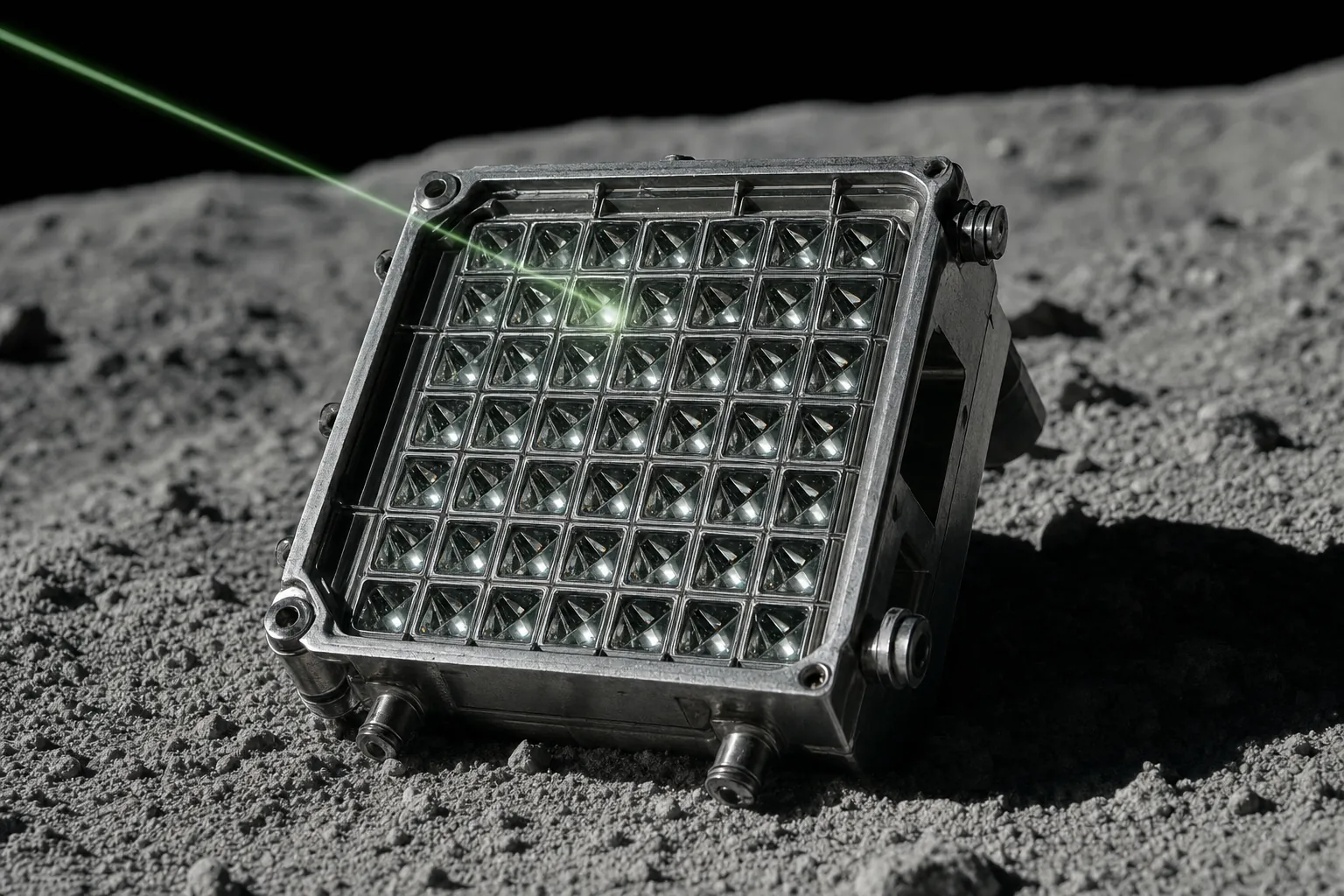
The retroreflectors on the Moon still return laser pulses tonight. Start there, and most of the famous space conspiracy theories fall apart — here is each one, with the physics and the sources.
01 Were the Moon landings faked?
Verdict: False
Claim: The Moon landings were faked.
Decades of independent evidence confirm the Apollo landings happened: retroreflectors left on the lunar surface by Apollo 11, 14, and 15 are still used today by observatories on Earth to bounce laser beams off the Moon, and lunar samples returned by the missions have been studied and verified by scientists worldwide, including outside the United States.
The claim also requires believing thousands of engineers, and rival Cold War-era Soviet trackers monitoring the missions independently, stayed silent about a hoax — a scenario with no supporting evidence.
SourceRoyal Museums Greenwich
02 Do the Van Allen radiation belts make travel to the Moon impossible?
Verdict: False
Claim: The Van Allen radiation belts make travel to the Moon impossible.
The Van Allen belts are real regions of trapped high-energy particles, but Apollo trajectories were deliberately designed to pass through the thinner sections of the belts quickly, limiting astronaut radiation exposure much like briefly walking across hot coals limits heat transfer to the feet.
As Prof. Anu Ojha put it, because the spacecraft moved fast enough to reach the Moon, passage through the belts was "no problem whatsoever." The belts' structure and intensity were well mapped by satellites like Sputnik 2 well before Apollo flew.
03 Why are there no stars in the Apollo photographs?
Verdict: Camera exposure, not a soundstage
Claim: There are no stars in Apollo photos, so the landings were staged.
The lunar surface at midday is as brightly lit by the Sun as Earth's surface, so Apollo cameras were set with a fast shutter speed and narrow aperture to correctly expose the astronauts and bright lunar terrain.
Those same settings are far too fast and narrow to register the comparatively dim light of background stars, which is a basic and well-understood limitation of photographic exposure, not evidence of a soundstage. The lunar sky appears black not because it's night, but because the Moon has no atmosphere to scatter sunlight into a blue sky.
SourceDiscovery
04 Is the International Space Station faked with green screens and wires?
Verdict: False
Claim: The ISS is fake, produced with green screens and wires.
NASA spokesperson Sandra Jones stated flatly that "at no time have props, green screens, wires, or simulated underwater settings replaced real-time operations on the space station," and Harvard astrophysicist Jonathan McDowell confirmed that amateur radio operators worldwide detect a real Doppler shift in signals from ISS crew — a shift that only occurs because the transmitter is genuinely moving at orbital speed.
Footage some viewers mistake for staged "wire" moments typically shows astronauts adjusting headset cables, or underwater training at NASA's Neutral Buoyancy Lab used to simulate weightlessness, not actual orbital operations.
SourceAP News
05 If you can't see the curvature, is the Earth flat?
Verdict: False
Claim: Flat Earth — you can't see the curvature, so Earth must be flat.
Earth's curvature has been directly photographed for nearly a century: in 1930, Capt. Albert Stevens photographed the Andes Mountains from 21,000 feet, showing peaks taller than his aircraft nonetheless hidden below the horizon due to curvature, and in 1935 a high-altitude balloon photograph clearly showed the horizon's curve alongside the troposphere-stratosphere boundary.
Everyday observations — such as ships disappearing hull-first over the horizon, and different stars being visible from different latitudes (Polaris is only visible from the Northern Hemisphere) — are also only explainable on a curved, not flat, Earth.
SourceSpace.com
06 Is the "Face on Mars" an alien-built artifact?
Verdict: Pareidolia
Claim: The "Face on Mars" is an alien-built artifact.
The famous "face" comes from a 1976 Viking 1 Orbiter image taken from 1,873 km away, under a low 20-degree sun angle that cast shadows creating a face-like illusion; some of what looked like an "eye" was actually a data-transmission error (a "bit error"), not a real feature.
When NASA's Mars Global Surveyor imaged the same mesa in 1998 at ten times higher resolution, the apparent face disappeared, revealing an ordinary eroded rock formation about 1.5 km across — a case of pareidolia, the same effect that makes people see faces in clouds.
07 Is Nibiru / Planet X a hidden planet on a collision course with Earth?
Verdict: Internet hoax
Claim: Nibiru/Planet X is a hidden planet that will collide with Earth.
Astronomers have explicitly called Nibiru an "Internet hoax" with "no factual basis" — if a rogue planet were actually on a collision course with Earth, it would have been tracked by astronomers for at least a decade beforehand and would already be visible to the naked eye.
The dwarf planet Eris does exist, but it stays in the outer solar system, with its closest possible approach to Earth still about 4 billion miles away.
SourceSpace.com
08 Are contrails secret "chemtrail" chemical spraying?
Verdict: Ordinary ice crystals
Claim: Contrails are secret "chemical mind-control spraying" ("chemtrails").
What people see behind aircraft are ordinary contrails: ice crystals that form from water vapor in engine exhaust condensing and freezing in the cold, humid air typically found above 25,000 feet at temperatures of -40°F or colder.
Persistent contrails aren't a different substance being "sprayed" — they last longer simply because the surrounding air at altitude happens to be especially cold and humid, the same physics that governs why ordinary clouds sometimes linger and sometimes dissipate quickly. Any aircraft, military or civilian, will produce a contrail if it flies through sufficiently cold, moist air.
SourceContrailScience.com
09 Do shadow and lighting "anomalies" in Apollo photos prove the landings were staged?
Verdict: Perspective effect
Claim: Shadow and lighting "anomalies" in Apollo photos prove the Moon landings were staged.
Non-parallel shadows in Apollo photographs are a normal perspective effect: when a flat, wide lunar surface is captured in a two-dimensional photo, parallel lines (including shadows from a single distant light source, the Sun) can visually appear to converge or diverge — the same effect seen in photos taken on Earth when the sun is low in the sky.
There was only one true light source on the Moon during Apollo missions, and detailed shadow-geometry analyses (such as those conducted by researchers on sites like Metabunk) consistently reproduce the "anomalies" using simple optics and terrain variation, not multiple studio lights.
SourceRoyal Museums Greenwich
Nine claims, nine verdicts. Each answer stands alone and cites the evidence it rests on, so it can be checked — or quoted — without reading the rest of the page.
Debunking is part of the affordability argument: public support for spending on orbit erodes when the record is in dispute.
See what is actually happening →